
Poetry: The Ultimate Freedom
John Bemis reviews three new books from Phillip Shabazz
All of us at Table Rock Writers Workshop—whether we’ve taken one of Phillip’s poetry workshops as part of the Free Nation of Shabazz or not —know and love his bigger than life presence.
While traditionally he’s written for adult readers, this year Shabazz has not one, but three new books that have all come out in 2026 that are all primarily for young readers. Although don’t let that fool you. These are delights for readers of all ages.
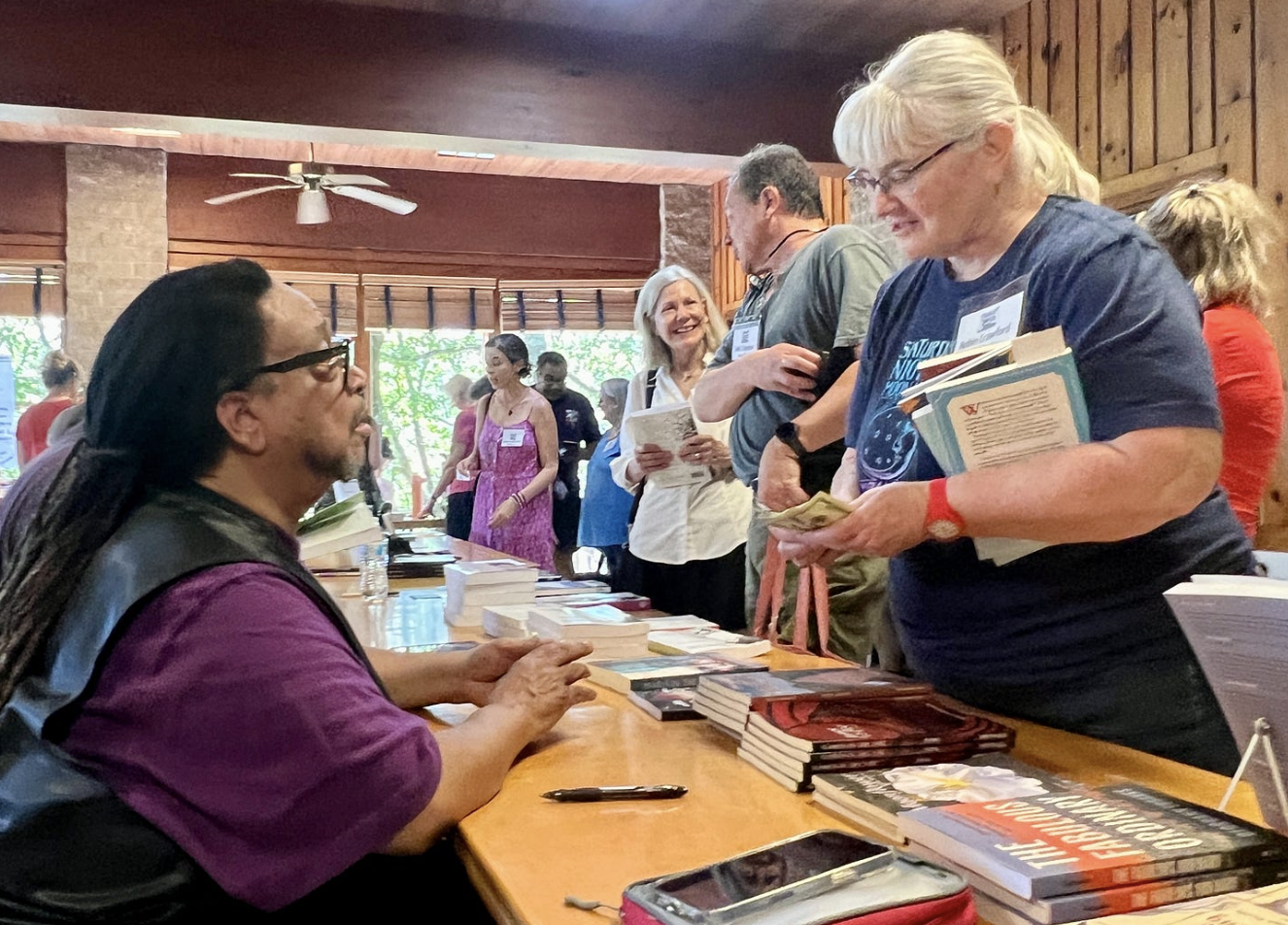
Phillip Shabazz at the Table Rock 2026 books sale (Photo by Donna Campbell)
When not with us up at Table Rock, Phillip spends much of the year out presenting in schools. He’s beloved by teachers and kids and often is invited back to the same schools year after year. Even my daughter, who is now in college, still gets excited when she remembers when Phillip led a weeklong poetry workshop at Hillsborough Elementary back when she was in third grade. It was an unforgettable experience for her.
Phillip told me this summer, “Poetry for most of the young people I work with is an outlet to express and share what’s going on in life—with friends, family, how they see the world. It’s ultimate freedom for them.”
Notice that word ‘freedom.’ It means something quite different to kids and teens than it does to us as adults. Young people are at a place in life where they lack a certain amount of freedom. Naturally. It just goes with the territory. Adults rule over and run their lives. Young people can feel a certain lack of power, agency, and control over their circumstances.
Phillip’s three books, while wildly different from one another, all explore the ways kids and teens stake claims to their lives — the lives they have and the lives they hope to have one day.
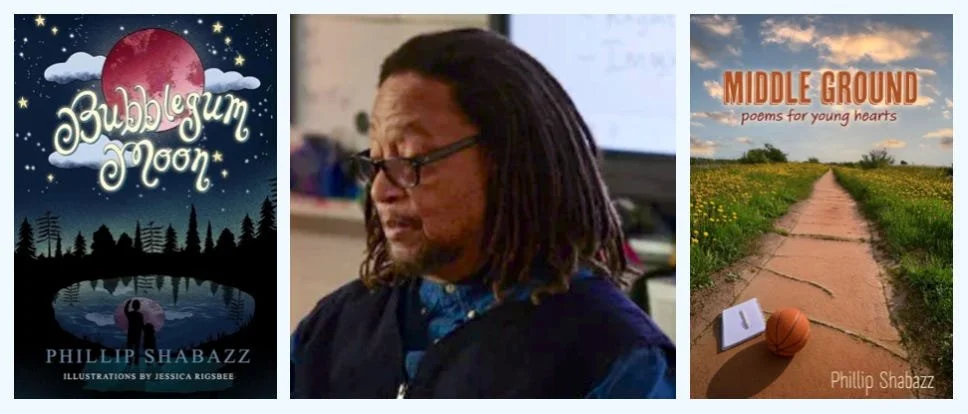
The poetry collection Bubblegum Moon (April 2026) is ideal for elementary school readers, while the poetry collection Middle Ground (July 2026) speaks more to tweens and teens (and as Phillip states in his subtitle, to all those have “young hearts”). The third, Pearls in the Sea, is a novel, although you won’t be surprised to know it’s teeming with poetic language, and most solidly addresses the world of teenagers.
“The poetry collections are different from what I’ve done before,” Phillip told me. The poems arose directly from his school visits, whether in elementary, middle, or high schools. Often, he’d write the first draft while with the kids and revise them later at home. Eventually he’d accumulated enough material to sort them into two collections.
His book Middle Ground begins with a series of poems that Phillip describes as “this and that,” but then takes readers on a journey through the seasons—seasons both metaphorical and literal.
Some of the poems celebrate childhood joys and innocence, as in “Turning Twelve”:
12 silver coins burning my pocket like summer rain.
12 wishes blown into a cloud of chocolate smoke.
12 Carolina breezes stealing the ice cream before it drips.
12 kids at the pool, cannonballs splitting the world in half.
Others, like “The Question,” honor the pain when parents separate, or illuminates those feelings of loneliness, smallness, and loss that young people feel, as in “Growth Hurts.”
Childhood is ultimately a transformation. We go from complete dependence as little diaper-wearing babies to incrementally more and more independence as we climb our way through childhood until we eventually reach adulthood. (If you’re not there yet, you’re not alone.) Shabazz understands how the many steps and stages of childhood shape kids and teens. He knows that a fourth grader sees the world in wildly different ways from a middle schooler or a high school junior. His writing speaks of the varied struggles and wonders with honesty and wisdom.
In his poem, “Compass: A Letter to My Student,” he empowers his readers:
You trusted the ache in your chest to tell you which direction is North.
That is not a small thing. That is everything.
So, when the snow finds you again, and it will, remember
You already know how to walk through it. I taught you that.
You proved it with more courageous pride than I’ve ever shown you.
Shabazz’s collection Bubblegum Moon takes a lighter, but just as rich, tone. The poems here, which range from limericks to odes, cinquains to ballads, rhyme to free verse, are full of silliness and play. Put it on the shelf next to your Shel Silverstein.
If you’ve been around a third grader for any meaningful amount of time, you know kids adore the absurd. The weirder and wackier, the better. And Shabazz delivers. A sneeze fills a room with cheese. Freddy Spaghetti performs feats with noodles. There are sly cockroaches and madcap squirrels.
There are haunted houses, ghosts, dragons, and magical libraries. There are also the everyday things that delight children: donuts, mashed potatoes, soccer balls, and grandmas. And there are the strange but true: a kid with gray hair, a barefoot teacher.
And of course, there’s the titular Bubblegum Moon, which returns, like the moon itself, in many phases across this poetry collection. The imagery of a bubblegum moon is so captivating and such a novel expression. Shabazz takes full advantage of it, with more than twenty poems across the collection featuring variations on this playful moon. Sometimes it’s an actual moon, sometimes it’s bubblegum. Sometimes it’s presented in a lyrical way, other times it’s alive and anthropomorphized.
With Middle Ground and Bubblegum Moon, readers have two very distinct—but both distinctively Shabazzian—poetry collections that will delight and inspire, tickle the funny bone and tug on the heart.

The third Shabazz book to grace readers this year is Pearls in the Sea, a novel about a teen struggling to be a poet in a world where those around him are simply struggling to survive. J-Man is a high school student from rough-and-tumble River Rock. For young men in his community, gangs like the Shock Boys terrorize their daily existence and others like the Club offer protection for those willing to pay the price.
J-Man is an artist in a world that values warriors. He’s a seeker — a passionate student of literature and of those in his neighborhood who can guide him on his intellectual and artistic quests. We’ve seen this sort of captivating protagonist, notably in James Joyce’s Portrait of an Artist as a Young Man, the young artist trapped by his environment who simply needs to get by until he can get out.
What’s different—and most powerful—about Shabazz’s protagonist is that J-Man is willing to fight back the only way he knows how: through his poetry. He’s not just the sensitive, observant artist. He’s willing to step into the arena, take action, and make a difference.
The writer François de La Rochefoucauld said, “We gain more by letting the world see who we are then by trying to seem what we are not.” Ultimately, this is J-Man’s journey—and his struggle. He’s discovering how River Rock, the people in his life, the experiences he has, and who he’s becoming gives him a singular voice as a poet. It’s a powerful message for all of us, whether we’re teenagers or not.
While these three works have been years—if not decades—in the making, they’ve all landed within a couple of months of one another. It’s been a fruitful year for Shabazz. A year of taking bold swings, of adventuring into new terrain. He and readers will be rewarded for his efforts. And we’ll be all the more excited for what might come next from our beloved Table Rocker.
John Claude Bemis is the award-winning author of six middle-grade novels, a picture book, and the Rodeo Hawkins graphic novel series. A former elementary school teacher, John earned his Master’s of Education in Literacy from UNC Chapel Hill and taught fourth and fifth grades for thirteen years. He received the Excellence in Teaching Award from UNC-Chapel Hill for his work as an author-presenter in schools and served as North Carolina’s Piedmont Laureate for Children’s Literature, promoting literacy and the literary arts. A popular instructor and inspiring guide to writers of all ages—kids, teens, and adults— he teaches creative writing workshops and leads retreats both at Table Rock Writers Workshop and around the world. Beyond the creative expression of writing, John is also a sculptural mask-maker, a songwriter, and musician. He lives with his wife and daughter in Hillsborough, North Carolina.